Field Marshal Asim Munir’s US Visit Signals New Chapter in Pakistan-US Military and Diplomatic Ties
Field Marshal Asim Munir’s visit to the U.S. signals a renewed phase in Pakistan-US military and diplomatic ties, focusing on counterterrorism, regional stability, and strategic cooperation.
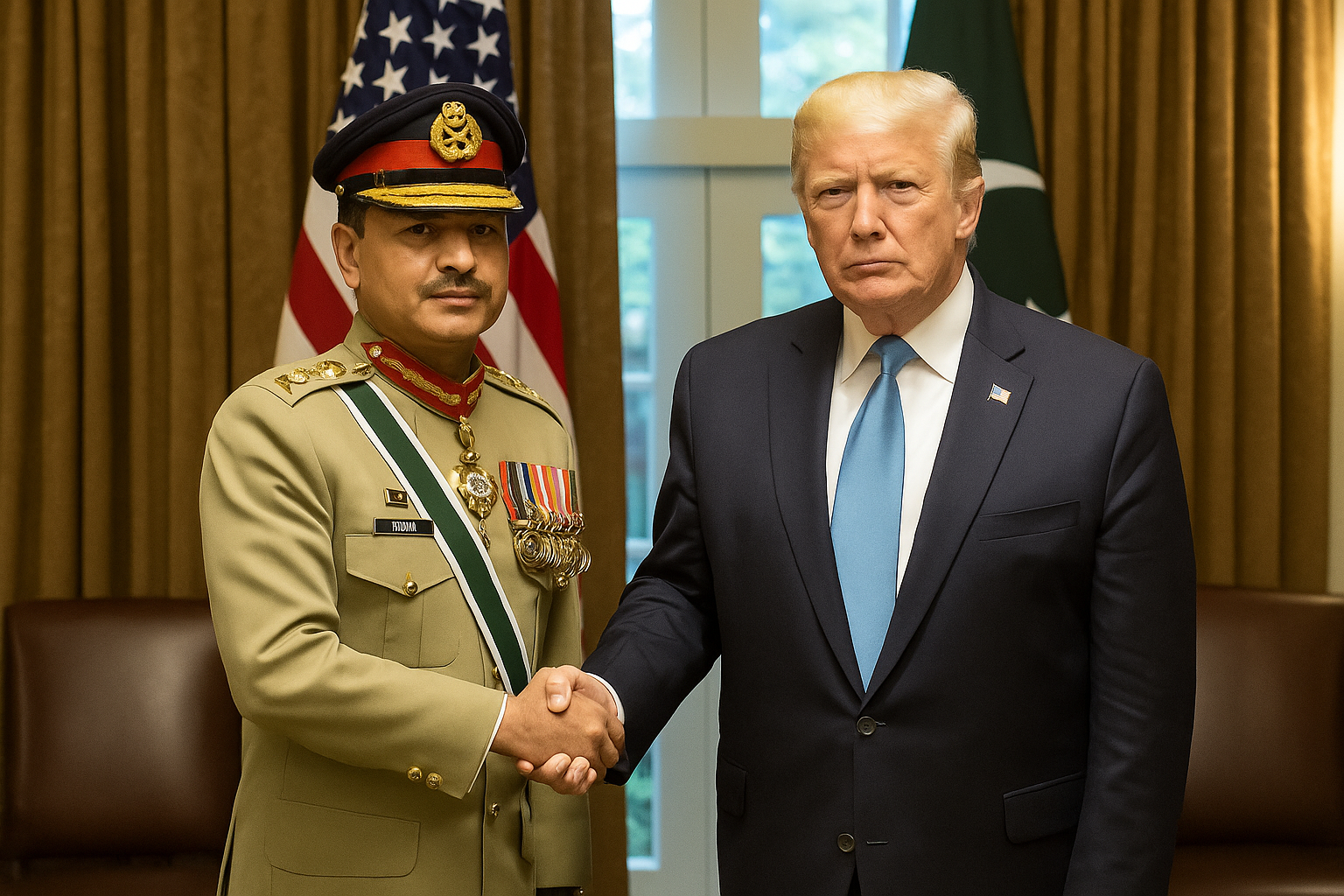
In a significant development for Pakistan’s international diplomacy and military engagement, United States President Donald Trump is set to host Pakistan’s Chief of Army Staff (COAS), Field Marshal Syed Asim Munir, for an exclusive luncheon at the White House on Wednesday, June 19 at 1:00 PM. The meeting, which will take place in the Cabinet Room behind closed doors, is being regarded as a symbolic and strategic engagement between two nations navigating complex global and regional dynamics.
This visit marks Munir’s first high-level foreign trip since his recent elevation to the rank of Field Marshal, a rare and historic promotion within Pakistan’s military hierarchy. The five-day visit, which began on June 15, comes amid growing concerns about regional instability, especially following an earlier diplomatic exchange between an Indian delegation and US Vice President JD Vance. Observers note that Munir’s direct White House engagement serves as a counterbalance in South Asian diplomacy, reaffirming Pakistan’s strategic relevance to Washington.
Stronger Voice for Overseas Pakistanis and Regional Diplomacy
During an address to the Pakistani-American community at the Four Seasons Hotel, Munir struck a balance between firmness and diplomacy. Emphasizing Pakistan’s commitment to peace, he dismissed Indian accusations linking Pakistan to the April Pahalgam attack as baseless and inflammatory. “We would rather embrace martyrdom than accept this dishonor,” Munir stated, sending a clear message against what Pakistan considers provocation under the guise of counterterrorism rhetoric.
He urged India to re-engage through dialogue rather than confrontation, reaffirming Islamabad’s position that peace in South Asia hinges on mutual respect and accountability. Munir also touched upon Pakistan’s broader foreign policy alignment by expressing support for Iran in its ongoing conflict with Israel, while simultaneously backing the United States’ de-escalation efforts in the Middle East. “We want this war to end immediately,” he declared, highlighting Pakistan’s call for regional stability over geopolitical rivalries.
Counterterrorism Cooperation Gains Spotlight
Another critical element of Munir’s US visit is the strengthening of counterterrorism cooperation between Pakistan and the United States. General Michael Kurilla, head of US Central Command (CENTCOM), praised Pakistan’s role in combating extremism, especially against the Islamic State’s regional faction, IS-K (Islamic State Khorasan Province). He pointed to successful Pakistani operations that eliminated dozens of IS-K militants and facilitated the extradition of Mohammad Sharifullah, a key suspect linked to the 2021 Abbey Gate suicide bombing in Kabul, which had killed over 180 people, including 13 US service members.
“Pakistan remains a phenomenal partner in the fight against terrorism,” Kurilla noted, despite the sobering reality of over 1,000 terrorist attacks inside Pakistan in the past year, resulting in the deaths of 700 security personnel and 2,500 civilians. These numbers underscore both the scale of Pakistan’s internal security challenges and the urgency for collaborative international efforts to combat transnational terror threats.
A New Diplomatic Balance
Field Marshal Munir’s US visit reflects a nuanced evolution in Pakistan-US relations, one that moves beyond the conventional military aid paradigm. Instead, the focus is now on mutual respect, intelligence cooperation, and a recalibrated understanding of strategic interests, particularly in a region where great power competition and proxy conflicts have long shaped policy.
The closed-door lunch meeting with President Trump is symbolic of the trust and importance both countries place on military-to-military diplomacy. While no official press briefing is expected immediately after the meeting, insiders suggest that topics such as Afghan border security, nuclear non-proliferation, and regional stability will be on the agenda.
As Pakistan continues to navigate a complex geopolitical landscape—marked by tensions with India, instability in Afghanistan, and shifting alliances in the Middle East—this visit by Field Marshal Asim Munir may very well set the tone for a more robust, transparent, and purpose-driven partnership between Islamabad and Washington.